

WordPress vs Custom Website: Which Is Better for Your Business? (2026 Guide)
WordPress vs Custom Website: Which Is Better for Your Business? (2026 Guide)
You’ve decided to get a website built — but now the next question: which technology? Some say WordPress is best, others say custom development. Both are right in their place — things only go wrong when the wrong technology is picked for the wrong job.
In this guide we’ll compare the two honestly: what the benefits of a WordPress website are, when custom web development is actually necessary, and which one is right for your business.
Key Takeaways (2-minute summary)
- WordPress (CMS): fast, cheaper, and you can update it yourself — enough for most business websites in Pakistan
- Custom website (technology like Laravel/React): more flexible and powerful — but more expensive and slower; only for complex systems
- A WordPress website usually costs PKR 40,000–150,000; custom development starts at PKR 200,000+
- The rule for deciding: requirement first, technology second — the technology should follow the requirement, not the other way round
- Neither technology is “bad” — using the wrong one is what’s bad
In this guide:
– Quick Comparison Table
– What Is WordPress? (Strengths + Limits)
– What Is Custom Development? (Strengths + Limits)
– Cost Comparison — PKR Ranges
– Which One Is Right for Your Business? (Decision Guide)
– 3 Common Myths — And the Reality
– FAQs
WordPress vs Custom Website — Quick Comparison
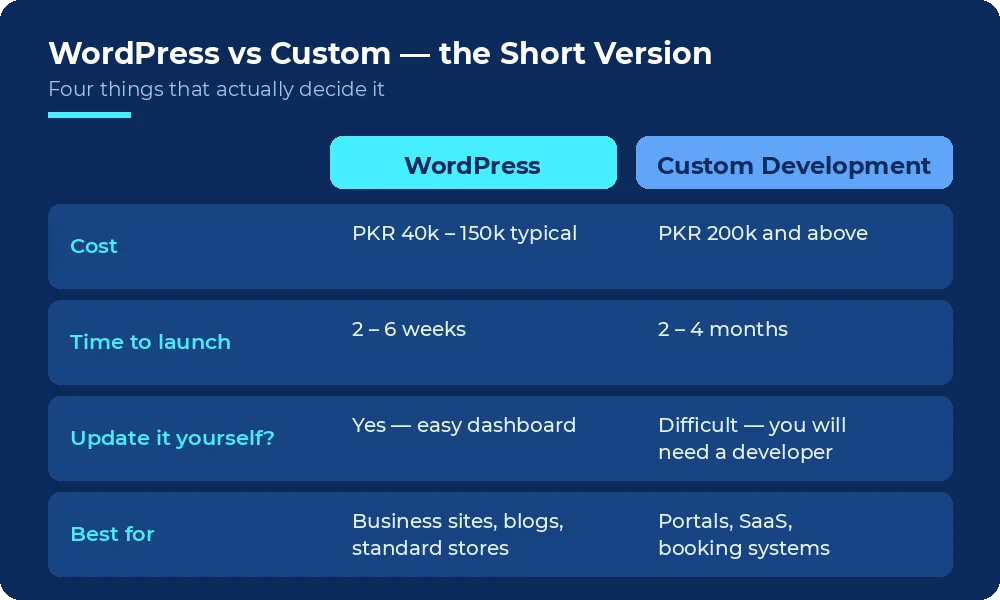
| WordPress (CMS) | Custom Development | |
|---|---|---|
| Cost | Lower (PKR 40k–150k typical) | Higher (PKR 200k+) |
| Time | 2–6 weeks | 2–4 months |
| Flexibility | Limited to what plugins can do | Unlimited — you can build whatever you want |
| Can you update it yourself? | Yes, an easy dashboard | Difficult — you’ll need a developer |
| Maintenance | Regular updates are a must (core, plugins) | Fewer updates, but you’ll need an expert |
| Best for | Business sites, blogs, standard ecommerce | Portals, SaaS, booking engines, complex systems |
What Is WordPress? (Strengths + Limits)
WordPress is the world’s most popular CMS (Content Management System) — over 40% of the internet’s websites run on it. Think of it like a ready-built house: the walls, doors and wiring are already in place — you just decorate it your way.
WordPress website benefits:
- Fast launch: Your website is ready in weeks — no waiting around for months
- Cheaper development: Because of ready-made tools (themes, plugins), the cost stays low
- You can run it yourself: A new page, image or blog post — from a simple dashboard, no developer needed
- WooCommerce: Runs on WordPress — the most common and cheapest route for online stores in Pakistan (with JazzCash/EasyPaisa integration)
- SEO-friendly: Basic SEO setup is easy with plugins like RankMath/AIOSEO
- Page builders: With tools like Elementor, the design is built with drag-and-drop
WordPress’s limits (honestly):
- Very specific features are hard: If you need a system that doesn’t exist in any plugin, WordPress has to be forced — and forced work breaks
- The update burden: Core, theme and plugin updates are a must on a regular basis; neglect them and you have a security risk
- Speed needs attention: Load up the wrong plugins and the site slows down — with a good setup this isn’t a problem, but it needs care
- It can’t do “everything”: A customer portal, a multi-vendor marketplace or a SaaS product — for these, WordPress becomes a forced fit
What Is Custom Development? (Strengths + Limits)
Custom web development means the website is built in code from scratch — on Laravel (a PHP framework) or modern technology like React. This isn’t a ready-built house; it’s a house built by an architect: every wall exactly where your needs say it should be.
Custom development’s strengths:
- Unlimited flexibility: Whatever you can think of, you can build — no plugin limits
- Complex systems: Booking engines, customer dashboards, multi-role portals, SaaS products — this is its home ground
- Performance: No extra baggage — only the code that’s needed, so it’s fast
- Security control: In your own hands — important for sensitive applications like banking/finance
- Scale: Can be designed to grow to millions of users
Custom development’s limits (honestly):
- Expensive: It takes developer hours — the cost is many times higher than WordPress
- Slow: 2–4 months is normal; if you need it fast, this isn’t the route
- You can’t change anything yourself: Even a small text change needs a developer (or a separate admin panel has to be built — which pushes the cost up further)
- Dependence on one developer: Without the person who wrote the code, moving forward is hard — documentation and handover are essential
Cost Comparison — Real PKR Ranges (2026)
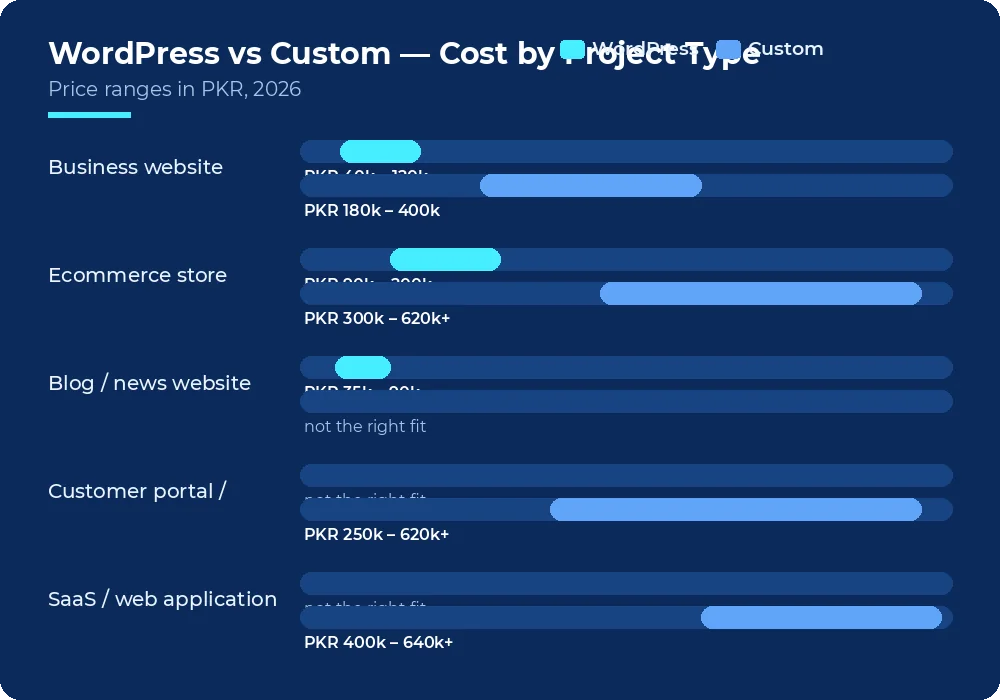
These are the ranges running in the market — an exact quote is always made after seeing the requirements (details in our website cost guide):
| Project Type | WordPress | Custom Development |
|---|---|---|
| Business website (8–10 pages) | PKR 40,000 – 120,000 | PKR 180,000 – 400,000 |
| Ecommerce store | PKR 90,000 – 200,000 (WooCommerce) | PKR 300,000 – 600,000+ |
| Blog/News website | PKR 35,000 – 90,000 | (You simply don’t need it) |
| Customer portal / booking system | (Difficult / a forced fit) | PKR 250,000 – 600,000+ |
| SaaS / web application | (Not the right route) | PKR 400,000+ |
Remember: A cheap technology can end up expensive if it isn’t right for your job — and an expensive technology is a waste of money if you don’t need it. Decide on the requirement, not the price tag.
Which One Is Right for Your Business? (Decision Guide)
The simple rule — “if X, then Y”:
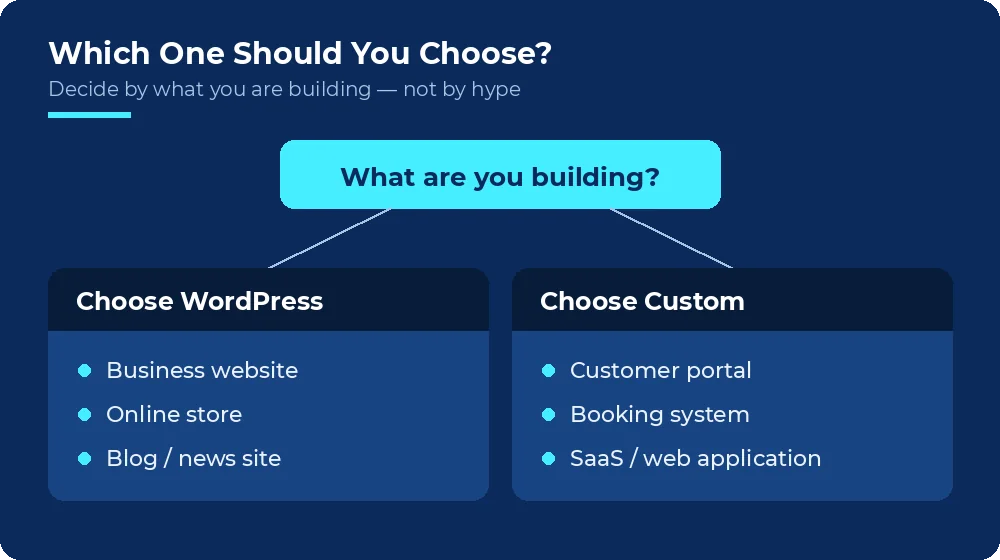
- If you have a small/mid-size business (clinic, law firm, restaurant, real estate, manufacturer) and you need a professional online presence → WordPress
- If you want to open an online store (50–500 products, JazzCash/EasyPaisa payments) → WordPress + WooCommerce
- If it’s a blog or news website → WordPress (this is what it was made for)
- If you need a customer portal (login, dashboard, order history, your own data) → Custom development (Laravel)
- If you have a complex booking/appointment system (multi-branch, staff roles, payments, notifications) → Custom development
- If it’s a startup’s SaaS product → Custom development (Laravel + React) — no debate here
- If your budget is tight and you need to launch fast → WordPress — launch first, upgrade later
Advice worth remembering: Launching on WordPress first and validating the business is often the smart move. Once the customers and revenue come in, invest in a custom system — on evidence, not on guesses.
3 Common Myths — And the Reality
Myth 1: “WordPress is only for blogs”
Reality: That was true in 2005. Today WooCommerce is one of the world’s biggest ecommerce platforms, and corporate websites, news portals and membership sites all run on WordPress.
Myth 2: “A custom website is always better”
Reality: Better for whom? For a simple business website, custom development means 3x the cost and 3x the time — and in the end, the same thing WordPress gives you in weeks. The best technology is the one that fits your job.
Myth 3: “WordPress is insecure”
Reality: WordPress itself is secure — the problem is a bad setup: outdated plugins, nulled (pirated) themes, weak passwords. A WordPress site built by a good agency and kept updated stays perfectly safe. (Custom sites get hacked too, when the developer is careless.)
FAQs — WordPress vs Custom Website
What’s the biggest difference between a WordPress and a custom website?
WordPress is a ready-made CMS — fast, cheaper, and you can update it yourself. A custom website is coded from scratch (Laravel/React) — more flexible and powerful, but more expensive and slower. The difference is like a ready-built house vs a house built by an architect.
Can an ecommerce store be built on WordPress?
Absolutely — WooCommerce (WordPress’s ecommerce plugin) is the most common route for online stores in Pakistan. Products, cart, JazzCash/EasyPaisa payments, order management — you get everything, at a fraction of the cost of custom development.
WordPress vs Laravel — which is better?
They’re made for different jobs; it’s not a contest. WordPress is better for content websites, blogs and standard stores. Laravel is better for complex web applications, portals and SaaS products. The right question isn’t “which is better” but “which is right for my job”.
Does a WordPress website rank on Google?
Yes — Google looks at content and quality, not technology. With a good SEO setup, WordPress sites rank very well. SEO plugins (RankMath, AIOSEO) make the job even easier.
How long does a custom website take to build?
Usually 2–4 months — design, development and testing combined. A WordPress website, by comparison, is ready in 2–6 weeks.
Can I update a WordPress site myself?
Yes — that’s its biggest strength. You can change text, images, new pages and blog posts yourself from a simple dashboard. On a custom website, you need a developer or a separate admin panel for that.
Can I move from WordPress to custom later?
Yes, and it’s common practice: launch on WordPress, validate the business, then build the custom system when both the need and the budget are there. The data and content get migrated.
CMS vs custom code — what’s the difference in maintenance?
With WordPress, regular updates (core, plugins, theme) are a must — a monthly maintenance plan is recommended. With custom code there are fewer updates, but when they’re needed, you need an expert developer.
Which technology is right for a startup?
If your product is a simple website or store, WordPress — fast launch, low cost. If your product itself is a web application (SaaS, a platform), custom development (Laravel/React) — there’s no shortcut here.
Still confused? DM us or tell us about your business and requirements at contact@abizglobalservices.com — we’ll honestly tell you which technology is right in your case, even if it’s the less profitable option for us.
ABiz Global Services — specialists in both WordPress websites and custom web development (Laravel/React). See our work in the portfolio. More guides: Website Cost in Pakistan (2026), Ecommerce Website Cost: WooCommerce vs Shopify (coming), WordPress Maintenance Guide (coming).
— Ibrar Ul Hassan — CTO & Co-Founder, ABiz Global Services