

What Is AI Automation? A Plain-Language Guide for Small Business Owners
What Is AI Automation? A Plain-Language Guide for Small Business Owners
You have probably heard it: “Automate your business with AI.” But what does that actually mean — for your shop, your clinic, or your online store?
In plain words: AI automation means taking the work your team repeats every day and having software do it — answering questions, entering data, sending follow-ups, preparing reports. The AI part is the “smart” part: instead of fixed rules, it understands what the customer is saying and responds accordingly.
No technical background needed. This guide explains what AI automation is, what it is not, and where it fits in your business.
Key Takeaways (2-minute summary)
- AI automation = repetitive work done by software, where AI understands the customer’s message and responds
- It is not about replacing staff — it is about putting their time on better work
- Most common uses: customer replies (chatbot), lead follow-up, data entry, appointment reminders
- Always start with the most boring, most repeated task
- Cost: simple tools run $20–100/month; custom work is a one-time investment (detail: AI Automation Cost Guide)
In this guide:
– What Is AI Automation? (The Simple Definition)
– AI Automation vs Normal Automation — The Difference
– What AI Automation Is NOT (Common Myths)
– 5 Real Examples — For Pakistani Businesses
– Which Tasks Benefit — and Which Don’t
– Where Do You Start? (3 Steps)
– FAQs
What Is AI Automation? (The Simple Definition)
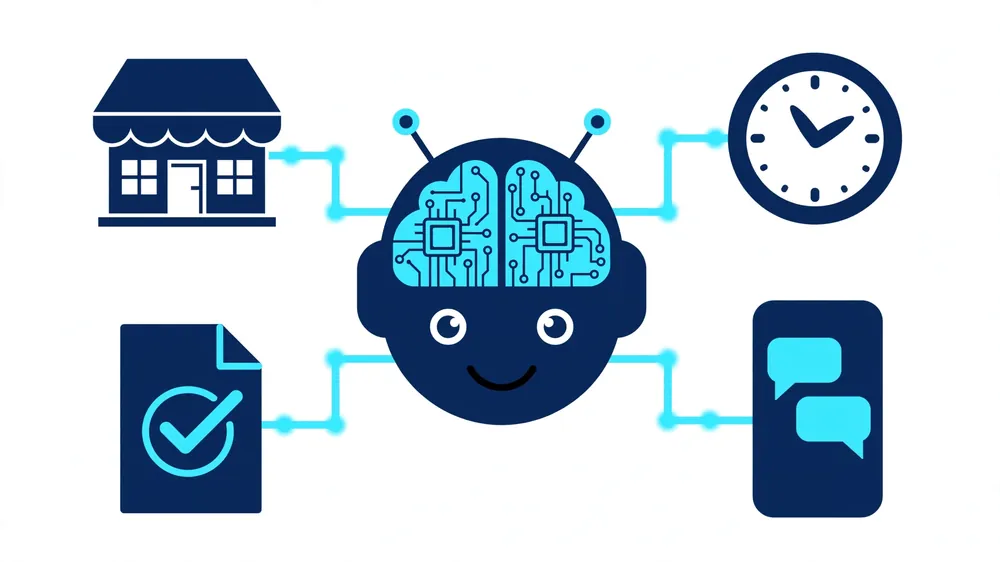
Every day, your team does this work:
- Answering the same 10 questions on WhatsApp
- Writing a new lead’s details into a register
- Following up with an old customer: “when will you visit again?”
- Tallying up the day’s sales every evening
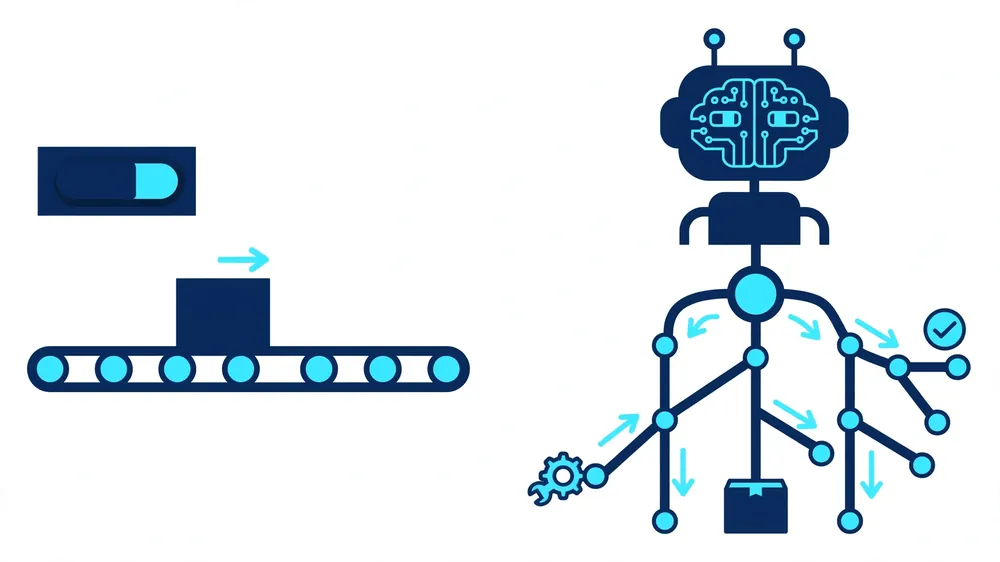
AI automation has software do these tasks. The only difference from older software is that the old kind worked on fixed rules (“if they write this, reply that”), while AI understands what the customer means — whether they write in Urdu, Roman Urdu, or with spelling mistakes.
Example: a customer writes “brother, is this suit available in medium?” — an old bot gets confused; AI understands the question: product = suit, size = medium, they want to know availability. And it answers.
AI Automation vs Normal Automation — The Difference
| Normal Automation | AI Automation | |
|---|---|---|
| Understanding | Fixed rules only (“press 1 for…”) | Understands the conversation, picks up context |
| Language | Only the set options | Urdu, English, Roman Urdu — however the customer writes |
| When something goes wrong | It gets stuck | It hands over to a human |
| Examples | SMS alert, auto-reply | Smart chatbot, lead scoring, smart follow-ups |
Both are useful — but wherever a conversation with the customer is happening, the AI version works better.
What AI Automation Is NOT (Common Myths)
“AI will run my whole business” — No. AI does the repetitive work; decisions, relationships and quality stay in your hands.
“I will have to fire staff” — The opposite: in most businesses the staff stays the same, they are just freed from the boring work and can focus on selling and service. We have seen it ourselves: after a chatbot is installed, teams are happier, not worried.
“This is only for big companies” — Not anymore. A WhatsApp chatbot or automatic follow-up is now within a small business’s reach. The “big investment” idea is outdated.
“AI will give perfect answers” — It won’t, and it shouldn’t try to. A good system brings a human in wherever the AI is not confident. That is a feature, not a flaw.
5 Real Examples — For Pakistani Businesses
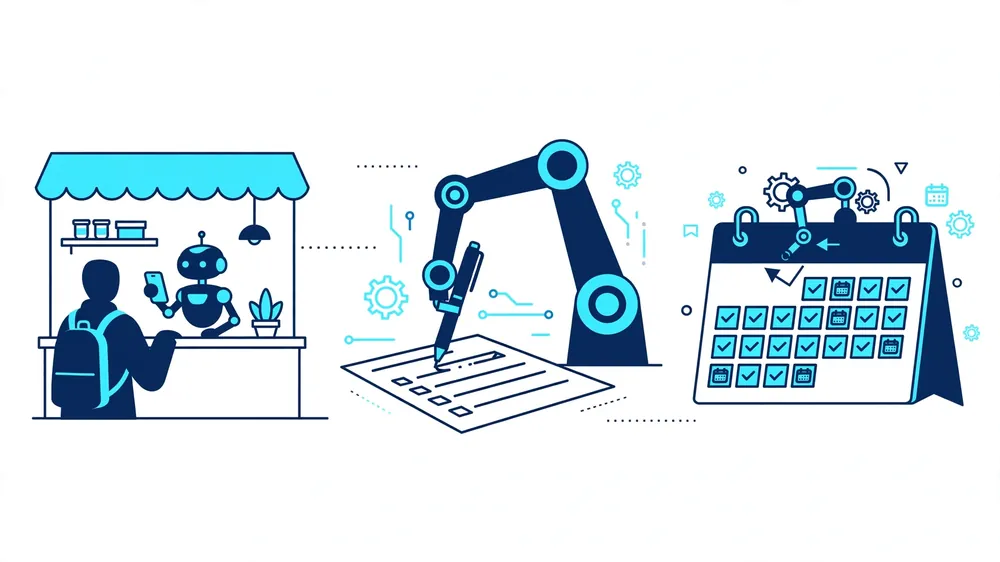
1. A WhatsApp assistant for an online store
Customer writes “price?” → instant reply + catalog link. Order confirmed → takes the address → COD entry goes into the system. 100+ messages a day, without the team lifting a finger.
2. Appointment booking for a clinic
A patient writes on WhatsApp, “I need an appointment for tomorrow evening” → available slots are shown → booking confirmed → a reminder goes out a day before. The no-show rate drops.
3. Lead follow-up for real estate
A new lead arrives → instantly gets the details on WhatsApp plus the option of a site visit. Two days later, an automatic follow-up: “Shall we plan the visit?” Leads don’t go cold.
4. Order flow for a restaurant
Send the menu → take the order → forward it to the kitchen → update the customer: “delivery in 30 minutes”. The hassle of taking orders on the phone is gone.
5. Quote automation for a service business
“What is the rate for AC service?” → AI asks for the area and AC type, gives an estimate → the human team confirms the final quote. No need to pick up the phone for every small question.
Which Tasks Benefit — and Which Don’t
Benefit (automate these):
- Work that repeats every day
- Where the answer is already known (prices, timings, location, process)
- Where speed matters (the faster the first reply, the warmer the lead)
Don’t (keep a human):
- Complex complaints and negotiations
- Where trust and relationships are built (big deals)
- Creative work (design, strategy)
The simple rule: boring + repeated = automate. Complex + relationship = human.
Where Do You Start? (3 Steps)
Step 1 — Pick one task
Write down the repetitive task that eats the most time. Most often, it is replying to customer messages. Start there — not with everything at once.
Step 2 — Run a small pilot
Start with a simple version: an FAQ chatbot or automatic follow-ups. Run it for 2–4 weeks and look at the result. If it works, expand it.
Step 3 — Measure
Measure the before-and-after difference: how much did reply time drop? How many more leads converted? How much team time was saved? The numbers will make the decision for you.
FAQs — AI Automation for Small Business
How much does AI automation cost?
Simple tools (Zapier/Make/n8n) run $20–100/month. A custom chatbot or automation: PKR 50,000–500,000 one-time, depending on scope. Full detail: AI Automation Cost Guide.
Does AI understand Urdu?
Yes — both Roman Urdu and Urdu script. Today’s AI models handle the way Pakistani customers write quite well.
Do I need to be technical?
No. You only explain your business — what the work is, what the answers should be. The technical implementation is our job.
What happens if the AI gives a wrong answer?
A good system checks its confidence — where it is not sure, it transfers to a human. You can also see a log of every conversation.
How long does setup take?
A simple chatbot: 2–4 weeks. Advanced (CRM integration, AI flows): 6–8 weeks.
Will my data stay safe?
A genuine provider keeps your data inside your own systems, with clear terms. Always get data ownership written into the contract.
Which of your business tasks could be automated? DM us or email contact@abizglobalservices.com for a free consultation — tell us your most boring daily task, and we will tell you how much automation would actually help.
ABIZ Global Services — AI automation, WhatsApp chatbots and business websites. See our work in our portfolio. More: AI Automation Cost · 5 Tasks to Automate (coming).